Shifts in Roulette Incentive Structures Amid Evolving Player Demographics in Virtual Environments
Clara Jung · Jun 25, 2026

Shifts in Roulette Incentive Structures Amid Evolving Player Demographics in Virtual Environments
Research indicates that virtual roulette platforms have adjusted their incentive models substantially since 2024, and these adjustments align with measurable changes in player demographics across online gaming ecosystems. Data from multiple jurisdictions shows younger users now constitute a larger share of active accounts, while mobile-first participants have surpassed desktop users in session frequency according to figures released by the Nevada Gaming Control Board. Observers note that platforms responded by replacing flat bonus offers with tiered rewards that factor in device type, play frequency, and preferred game variants. These modifications emerged as operators tracked participation patterns that diverged from earlier cohorts dominated by older desktop players.Demographic Transitions Driving Structural Adjustments
Statistics compiled through mid-2026 reveal that the 25-to-34 age bracket increased its representation in virtual roulette sessions by roughly 18 percent compared with 2023 baselines. At the same time, female participation rose across several European markets tracked by the Malta Gaming Authority, prompting operators to introduce gender-neutral reward pathways and customizable loyalty milestones.
Geographic distribution also shifted, with growth concentrated in regions where regulatory frameworks permit rapid platform updates. Players from these areas tend to favor shorter sessions on portable devices, and incentive programs adapted by offering instant cashback increments rather than long-term accumulation schemes.
Reconfiguration of Bonus Mechanisms and Reward Pathways
Traditional deposit-match structures gave way to dynamic scaling systems that recalibrate based on real-time behavior analytics. One common modification ties reward multipliers to the proportion of live dealer versus RNG rounds a participant completes, because engagement data showed mobile users gravitate toward interactive dealer formats.
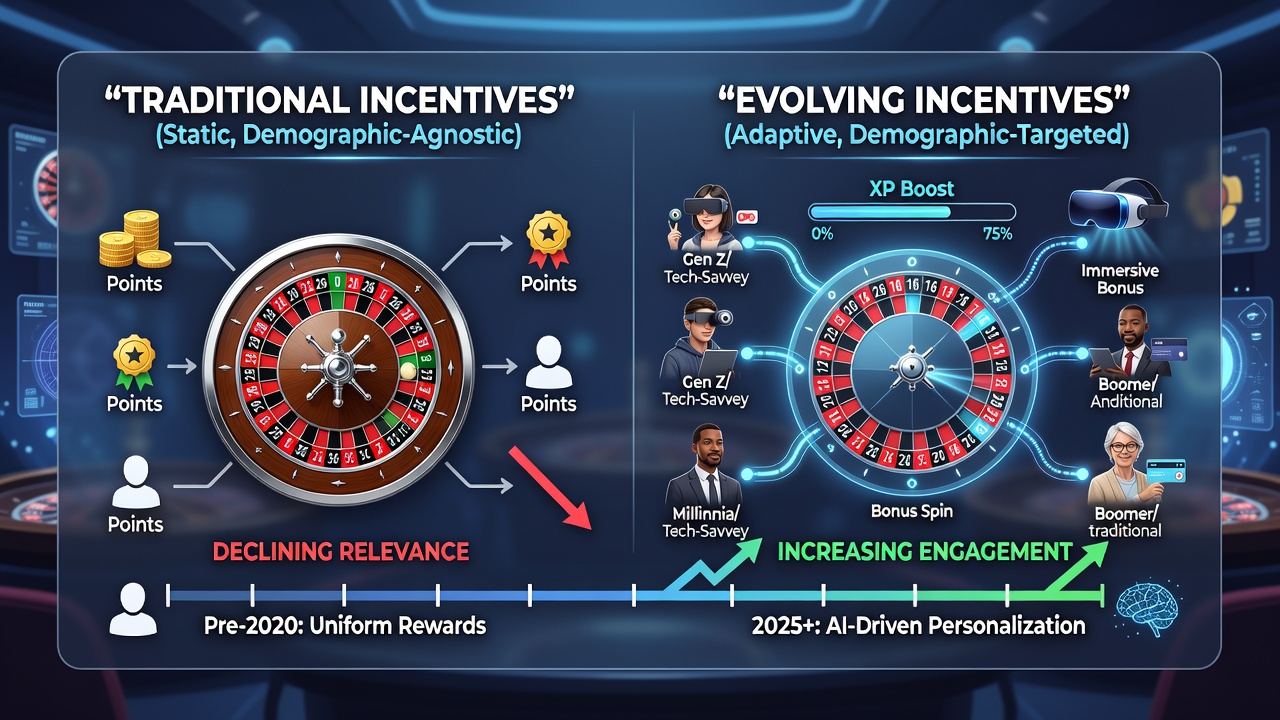
Platforms further integrated hybrid esports crossover elements in June 2026, allowing roulette participants to earn points transferable into tournament entries on partnered competitive gaming sites. This development coincided with an influx of users already familiar with battle-pass systems from other genres, and operators observed accelerated uptake when rewards mirrored those familiar frameworks.
Wagering requirements themselves underwent refinement, with several sites lowering thresholds for mobile-only play while maintaining stricter caps on desktop sessions. The adjustments reflect telemetry indicating portable-device users complete fewer but more frequent deposits, and reduced barriers help sustain retention without inflating operator liability exposure.
Regulatory and Platform Responses Across Regions
Regulatory bodies outside the United Kingdom have issued updated compliance guidelines that directly address demographic targeting. The Nevada Gaming Control Board, for instance, requires transparent disclosure of how algorithms personalize offers, while Australian state regulators emphasize responsible-gaming prompts calibrated to session-length patterns prevalent among younger cohorts.
Industry reports from the Canadian Gaming Association highlight that cross-border platforms serving multiple jurisdictions now deploy geo-specific incentive overlays, ensuring offers comply with local rules yet remain attractive to transient player bases. These overlays often manifest as time-zone-adjusted reload bonuses or region-locked free-spin pools that activate during peak hours for each market.
Retention Metrics and Long-Term Platform Adaptation
Longitudinal studies conducted by academic teams at institutions such as the University of Nevada, Las Vegas, track how altered incentive structures correlate with changes in lifetime player value. Early findings suggest that personalized cashback tiers produce steadier engagement curves than legacy volume-based systems, particularly among the expanding mobile demographic.
Platforms continue to test A/B variations that incorporate social features, such as shared leaderboards tied to weekly roulette challenges. These features appear most effective when paired with micro-rewards that users can claim immediately after each qualifying spin, matching the shorter attention windows documented in recent demographic surveys.
Conclusion
Virtual roulette ecosystems have therefore recalibrated incentive architectures to accommodate documented demographic evolution, and ongoing data collection will determine which configurations deliver sustained participation across diverse player segments. Regulatory oversight and platform analytics together shape the trajectory of these modifications, ensuring structures remain responsive to measurable shifts rather than static assumptions about user behavior.